Through these he has given us his very great and precious promises, so that through them you may participate in the divine nature, having escaped the corruption in the world caused by evil desires.2 Peter 1:4
Watch TV, scroll social media or listen to politicians, and the verdict seems clear: Americans are hopelessly divided and increasingly hateful.
It's a ubiquitous, emphatic, verifiable ... lie.
Why it matters: Most Americans are too busy for social media, too normal for politics, too rational to tweet. They work, raise kids, coach Little League, go to a house of worship, mow their neighbor's lawn — and never post a word about any of it.
This isn't a small minority. It's a monstrous, if silent, majority. Most Americans are patriotic, hardworking, neighbor-helping, America-loving, money-giving people who don't pop off on social media or plot for power.
The hidden truth: Most people agree on most things, most of the time. And the data validates this, time and time again.
Oh, but you're so naive, so delusional and detached from reality. Everywhere I look, I see dispute and decline!
But it's the terminally online news junkies who are detached from the actual reality.
We've been manipulated by algorithms and politicians amplifying the worst of humanity. Our feeds and screens spread a twisted, inaccurate view of America.
It makes it seem like the nation is hopelessly broken ... Political enemies are evil ... Facts are no different than fiction ... Morality, honesty and service don't matter ... And salvation can only come from magical technologies or a powerful few.
What if we told you it's a big lie that makes you stop believing your own two eyes?
Every day, people battle over outrageous things said on X. Did you know that four out of five Americans don't use X, and therefore don't see what you see? Pew Research Center found last year that only 21% of U.S. adults use X, and just 10% visit it daily. The loudest platform in politics reaches barely one in five Americans.
But what about the wacky claims made on cable TV? Did you know that during most hours of most prime-time nights, less than 1% of the country watches Fox News, CNN or MS NOW, combined?
Maybe, just maybe, it's the very people on these platforms who are the crazy ones.
Maybe, just maybe, most people are simply normal, sane, real.
A Gallup World Poll out last week found Americans are more anxious about their political system than citizens of almost any other country — yet the data consistently shows this anxiety is driven by the noise, not the neighbors. The system feels broken. The people are not.
Here's a good test: In a given year, you see hundreds of people frequently enough to appraise their character. Are they good people? Would they help shovel after a snowstorm or lift groceries for an aging neighbor? Do they volunteer and give to others?
We bet the answer is a resounding yes. This is America's Super Majority.
The numbers back this up. Americans gave $592.5 billion to charity in 2024 — a record, with individuals accounting for two-thirds of it.
Over 75 million Americans formally volunteer each year, and 130 million informally help their neighbors. Gallup research out last month found that 76% of U.S. adults gave money to a religious or other nonprofit organization in the past year, and 63% volunteered their time.
This isn't a broken nation. This is a generous one, where the vast majority quietly do the right thing every single day.
The bottom line: The next time your screen tells you America is broken, close it. Walk outside. Talk to your neighbor. Coach the team. Go to the town meeting. That's the real America — and it's a hell of a lot better than the one being manufactured for clicks, clout and cash.
🗳️ Want proof this is true for politics? Read Axios Finish Line tonight.
You've heard of yoga with kittens, and goats, and maybe even reindeer… but what about a bunch of pythons and one baby Columbian Common Boa named Mango?
Google is quietly expanding its Pentagon work — and growing users faster than its rivals — while Anthropic and OpenAI publicly spar over conditions for Defense Department work.
Why it matters: Winning the AI race may depend on knowing when to stay out of scuffles.
What they're saying: "When you have two major companies fighting each other, it is a good distraction for another company to come in and learn from their mistakes and just go all the way to the top," PitchBook's Harrison Rolfes tells Axios.
State of play: Google is set to provide AI agents to the Pentagon's 3-million-person workforce for unclassified work, Bloomberg reported Tuesday.
The news came just one day after rival AI lab Anthropic sued the Pentagon for classifying the firm as a "supply chain risk" after negotiations broke down over parameters for using Anthropic's Claude.
Between the lines: Google largely stayed out of that tête-à-tête.
"OpenAI looked opportunistic. Anthropic got blacklisted. Google gained the most ground and nobody's talking about it," Patrick Moorhead, CEO of Moor Insights & Strategy, told Axios.
This comes after Google has already been steadily gaining AI mojo.
Yes, but: Google DeepMind's chief scientist, Jeff Dean, signed the brief supporting Anthropic, and employees wrote letters to executives asking for broader support for Anthropic's safety goals.
So Google isn't immune to the internal dynamics pressuring its rivals.
The difference: Google has the cash reserves to take bigger hits than OpenAI or Anthropic.
Defense AI is "immaterial" to Alphabet's over $400 billion annual revenue base. But Moorhead also said the company needs to diversify its revenue away from consumer advertising to "balance the business."
Anthropic is projected to break even by 2028, OpenAI by 2030, according to The Information. PitchBook's Rolfes adds that OpenAI doesn't offer much detail on how to achieve that.
Flashback: Netscape and Microsoft defined the browser wars of the 1990s while Google was building a search business that would become ubiquitous.
What we're watching: Claude grew paid subscribers by over 200% year over year, Gemini 258%, with roughly 20% of weekly ChatGPT web users also using Gemini in a given week, according to January Yipit data compiled by a16z.
OpenAI and Anthropic are "essentially cannibalizing each other," keeping prices low to take market share from one another, Rolfes said.
While many enterprises are paying for subscriptions at both AI labs, neither is profitable.
Google is "most lined up to take that top spot" as the infighting continues.
President Trump wants to strike cartels inside Mexico. In Sinaloa State, a cartel stronghold, some residents said they were willing to entertain U.S. intervention.
Without this Education Department oversight, borrowers could "be placed in the wrong loan repayment status, billed for incorrect amounts" and more, the U.S. Government Accountability Office says.
Nearly half of Americans support the National Guard monitoring November's elections, potentially signaling an openness to the sort of nationalizing of elections that President Trump says he wants.
The Department of Justice is quietly restarting a decades-dormant program to restore gun rights to felons. One of them was an alleged fake elector in 2020.
Disaster costs fell in the U.S. in 2025. Still, it was the fourth time in five years that extreme weather inflicted more than $100 billion in annual losses. Industry experts say the growing financial toll will make insurers wary of rushing to cut rates.
Homeland Security Secretary Kristi Noem is on track to leave dozens of pending contracts on her desk when she leaves office in three weeks, the legacy of a system she imposed to cut "waste, fraud and abuse," but that has stalled DHS programs.
Why it matters: The backlog of contracts has left vendors waiting for payments and delayed projects such as President Trump's push for mass deportations and the border wall, along with disaster relief under FEMA, Axios has learned.
"There's a mountain of backed-up contracts and invoices on her desk that the new guy will just have to deal with," a source familiar with the situation at DHS told Axios.
The backlog existed long before the partial government shutdown over DHS immigration policies that began Feb. 14 and has further pinched the agency's spending.
The shutdown has touched most of DHS's 23 agencies, including ICE, Customs and Border Protection, FEMA, TSA and the Secret Service.
Zoom in: Noem's delay in approving DHS contracts stems from her requirement that agreements involving $100,000 or more — which is most of those at DHS — be reviewed and approved by her.
That policy — imposed just before Congress dramatically boosted DHS funding to implement Trump's immigration agenda — was disruptive enough that several vendors began charging DHS in contracts of $99,999 each in order to get paid.
The impact of Noem's policy can be seen in delayed DHS payments to vendors, causing disruptions now being compounded by the shutdown.
Dozens of ICE facilities currently holding detainees have contract extensions waiting for Noem's signature and are awaiting payments, two sources familiar with the agreements told Axios.
An agreement with Camp East Montana, an immigration facility in Texas that ICE data indicate held almost 3,000 people a day in mid-February, expired at the end of February. The facility's operator, Acquisition Logistics LLC, could not be reached for comment.
DHS payments for the family detention facility in Dilley, Texas, also lapsed in early March. Dilley is the only long-term detention unit that holds detainees' children. ICE records indicate that about 700 people were detained there as of mid-February.
Core Civic, which operates Dilley and several other detention facilities, said in an emailed statement, "We are hopeful the federal government will resolve budget matters to enable resumption of payments," referring to the shutdown. "In the meantime, we remain focused on operating safe, humane facilities, working closely with our government partner."
New Jersey's Delaney Hall, which held roughly 900 immigrants last month, also is operating without a payment after its government deal expired. Geo Group, the contractor, declined to comment.
Many small county jails that contracted with ICE to hold immigration detainees also are missing payments.
Zoom out: Congressional leaders grilled Noem last week about her department's delays in distributing disaster relief funds under FEMA.
"From everything that I've heard, it's still a giant sh*t show up there," a source familiar with FEMA's delays said of DHS's front office.
"The ramifications of her tenure are going to be felt for years and years and years and years," the source added. "We're not really going to know exactly how bad it is until we have a major hurricane that unfortunately impacts someplace in the United States."
Several contracts for another Trump priority, the border wall, also were stalled by Noem's sign-off system, as Axios previously reported.
As of mid-February, just 36 miles of border wall construction has been completed, according to CBP data. Nearly 2,000 miles were funded by Trump's "big beautiful bill."
What they're saying: DHS did not respond to a request for comment.
But Corey Lewandowski, Noem's "special government employee" and de facto chief of staff, told Axios in an interview that Noem was reviewing contracts last week, and that the shutdown limits certain spending.
He also said congressional leaders who questioned Noem on FEMA delays didn't understand that all the possible funding has been distributed.
Lewandowski defended Noem's contract approval policy, claiming it saved $15 billion last year.
"For 23 years nobody ... ever reviewed the spending of that department. I don't blame anybody. No one had the wherewithal or desire" to rein in spending, he said.
Lewandowski said he didn't have a role in signing off on contracts but that three of Noem's deputy chiefs of staff also were allowed to green-light contracts. He said contracts were on Noem's desk no more than 48 hours, though there were other reviews before they made it to her.
One of the sources familiar with DHS's situation said that even if Noem's review process is reversed and "everything goes back to the way it was ... it's going to take weeks, if not months, of constant work" to restore vendors' funding.
What's next: Trump's pick to succeed Noem, Sen. Markwayne Mullin (R-Okla.), didn't reply to a request for a comment on whether he'd continue Noem's sign-off system if he's confirmed by the Senate.
Lewandowski declined to say whether he'd recommend Noem's system to the next DHS secretary.
Rihanna, her partner A$AP Rocky, their three children and her mother were all at home when a woman now charged with attempted murder is alleged to have fired at the property, a prosecutor said.
DORAL, Fla. — President Trump's top advisers are urging House Republicans to turn the 2026 midterms into a choice election — and hammer Democrats on taxes, crime and border security.
Why it matters: Midterm elections are almost always referendums on the president and the party in power.
But Speaker Mike Johnson (R-La.) and Trump are looking to buck history and retain the House by focusing on the Democrats' national brand, with 52% of voters viewing the Democratic Party unfavorably.
Driving the news: At the House GOP retreat in sunny Doral, Florida, (high 84°) White House deputy chief of staff James Blair told lawmakers to stop emphasizing "mass deportations," Axios scooped earlier Tuesday.
Mass deportations were central to the GOP's 2024 campaign message, so Blair's advice captured attention. Instead, he told lawmakers, focus on deporting violent offenders.
The emerging strategy: remind voters of Democrats' Biden-era positions on crime, cashless bail and open borders, according to people familiar with the matter.
Zoom in: Blair was on a closed-door panel with Chris LaCivita, Trump's 2024 co-campaign manager, and Chris Winkelman, president of the Congressional Leadership Fund, an outside super PAC associated with Johnson.
The panelists, led by National Republican Congressional Committee Chair Richard Hudson, reminded lawmakers of the GOP's unprecedented cash advantage.
In a cycle with a small map, the party with stronger organization and clearer lines of control has the edge, the panelists said.
Blair also told GOP lawmakers to remember how Trump won in 2024. He challenged conventional wisdom: Don't feed into Democratic talking points, he said.
Zoom out: History is not on the GOP's side this November.
Republicans lost 41 House seats in Trump's first midterm. President Obama's Democrats lost 63 seats in 2010, the first midterm after he was elected.
Lawmakers in both parties are fleeing Congress at a record rate, with 34 Republicans and 21 Democrats planning to leave the House at the end of this Congress.
Trump is also a drag on Republicans as his favorability rating remains well underwater, with his approval rating in the low 40s.
Historically, the party with more departurestends to lose seats, and often the majority.
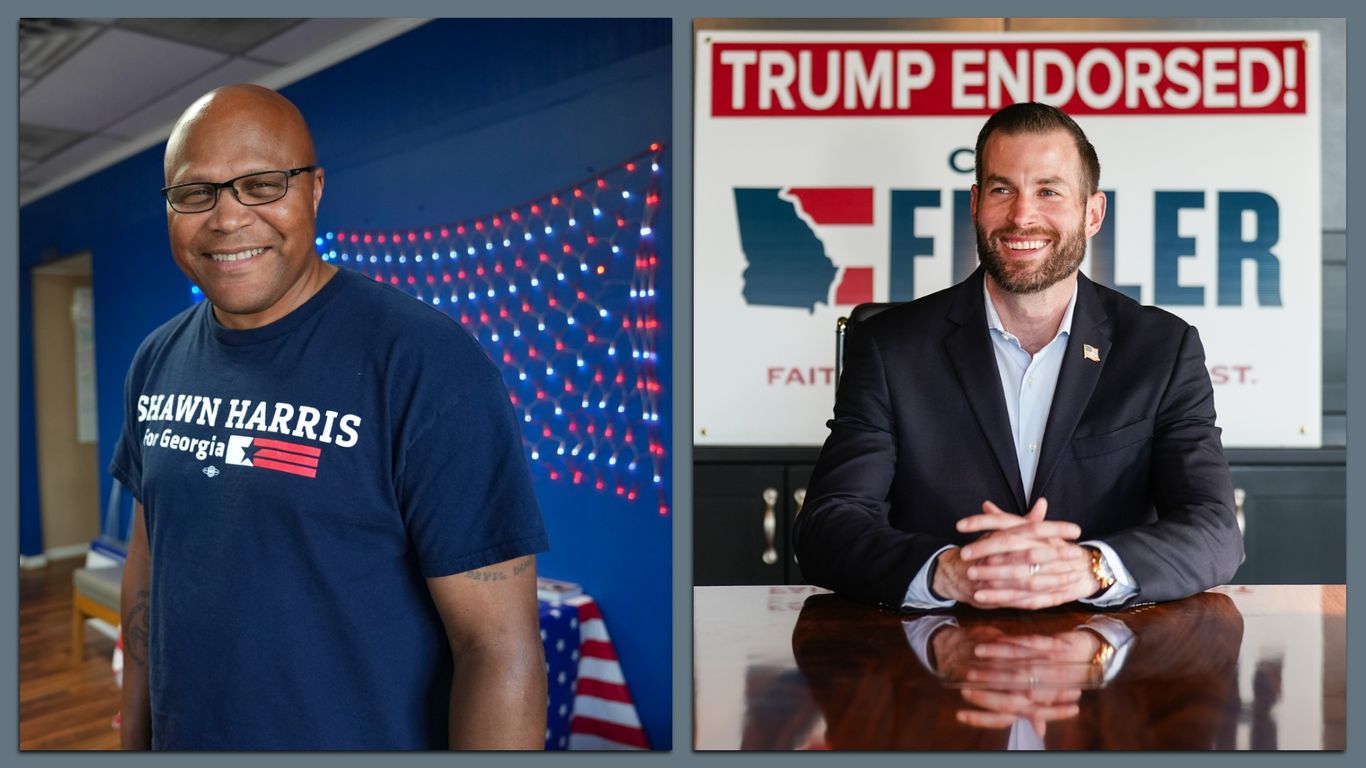
Trump-endorsed Republican Clay Fuller and Democrat Shawn Harris will advance to the April 7th runoff to decide who will replace former Rep. Marjorie Taylor Greene in Georgia, per AP.
Why it matters: Harris, who lost to Greene in 2024, raised more than $4 million during his campaign. A win for Democrats in the reliably red district would be significant.
The race also is being closely watched because Republicans are operating with a razor-thin majority.
That's more problematic than ever for Speaker Mike Johnson (R-La.) after Rep. Kevin Kiley (Calif.) announced this week that he's leaving the GOP to become an independent.
Flashback: Despite previously being one of Trump's staunchest allies, Greene resigned from Congress in November 2025 following a fallout with the president.
The country has prioritized self-sufficiency in producing a crucial battlefield weapon, though weaning itself fully off cheaper Chinese components is difficult.
Officials say Mojtaba Khamanei’s legs were hurt, but the circumstances as well as the extent of his injuries were unclear. He has remained out of view since being named leader three days ago.
Secretary of State Marco Rubio designated Afghanistan as a state sponsor of wrongful detention, accusing the Taliban of using terrorist tactics against Americans.